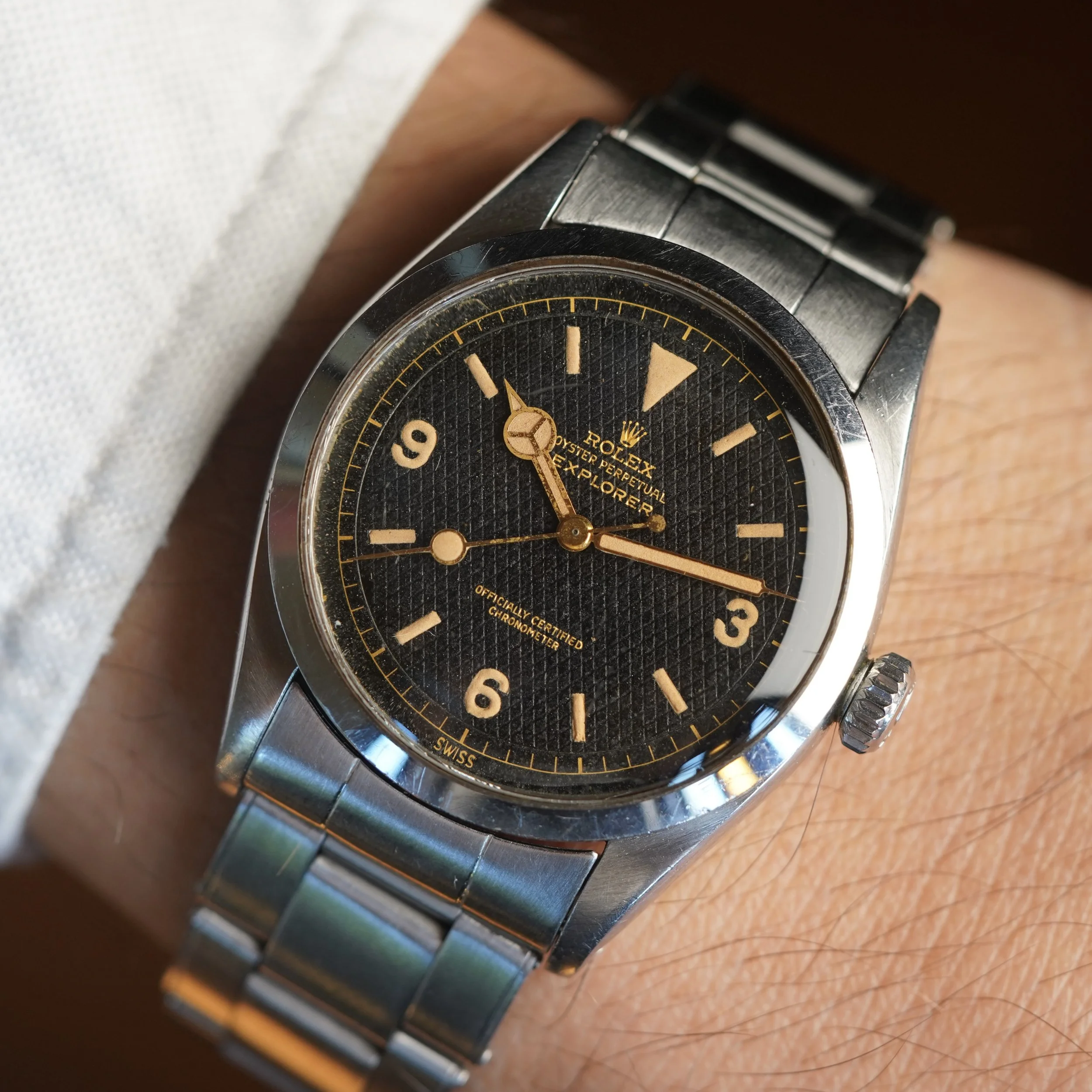
Explorer model

Rolex Explorer

Catalog example attributed to Rolex 6350 Honeycomb Ovettone
Catalog example: Rolex 6350 Honeycomb Ovettone. Sourced example; exact configuration not independently verified. Photo source: amsterdamvintagewatches.com

9 variants across 5 references

635066101016165516550

Rolex Explorer: 9 catalog configurations across 5 references. Compare specifications, identification notes and the evidence attached to each entry.

References
5 references
Variants
9 variants
Range span
$11,000 to $117,000
Photo set
12 images

A closer look

Notable examples

Explore the dial, bezel and case details through distinct examples, each linked to its original source.

Explorer references at a glance

5 references and 9 recorded configurations are summarized below. Production dates come from the catalog notes. Market ranges combine recorded dealer, auction and estimate fields for orientation only; open a guide before comparing condition or originality.

References at a glance
ReferenceProductionRecorded configurationsCatalog market rangeGuide
63501 configuration1953–1955Honeycomb Ovettone$38,000–$117,000Open guide →
66101 configuration1955–1959Gilt$8,400–$50,000Open guide →
10163 configurations1960–1989Gilt
Tropical matte
Matte
$7,000–$45,000Open guide →
16552 configurations1971–1984Freccione, Mk2-Mk5
Freccione, Mk1 straight hand
$12,400–$75,000Open guide →
165502 configurations1985–1989Cream Polar
White Polar
$9,000–$32,000Open guide →

How to narrow the comparison

  1. Start with the reference, then use the recorded configurations to identify the bezel, dial and case that match the watch.
  2. Open the guide for its catalog notes, photographs and any attached source links. Treat ranges as context, not a valuation.
  3. For a specific offered watch, request reference markings, service records and replacement-part disclosures. A shared reference number alone does not establish matching condition or originality.

Reference sources and price evidence

0 distinct reference sources are attached to these 9 catalog entries. 9 entries have no attached reference source; treat their specifications and historical notes as catalog claims awaiting verification.

0 of 9 entries have attached price-source links. Dealer ranges, auction ranges and catalog estimates are separate data categories, not live offers or verified transaction results. Check each linked page for asking versus sold price, sale date, currency, fees and the actual configuration; a source link alone does not establish those details.

Photographs illustrate sourced examples. Image-source links identify their origin; they are not reference research, proof of authenticity or a statement of image rights. No physical inspection is represented here. Read the editorial and evidence method.

Collector Read

Use the reference and configuration together to identify a watch in this family.

The family reads cleaner than Daytona or GMT-Master, which makes the mistakes harder to see. A simple black dial can hide a lot of market distance.

Use the page as a calibration tool. Early texture, giltGold-colored dial printing, usually on early glossy Rolex sport dials. It is one of the first details collectors use to date a watch. surface, later matteA flat, non-gloss dial surface. Many later vintage sport Rolex references moved from glossy gilt to matte printed dials. execution, and Explorer II oddness all belong to the same broad idea, but not the same buying logic.

The map covers 9 variants from $11,000 to $117,000. That is enough to make the point: simplicity is not the same thing as interchangeability.

Model Summary

Model
Explorer
Variants
9 variants
References
5 references
Range span
$11,000 to $117,000

Known Variants

Ref. 6350

An early reference bearing the Explorer name, with the recognizable 3-6-9 dial layout and honeycomb-dial examples.

Ref. 6610

This early 36 mm Explorer uses calibre 1030 and the familiar 3-6-9 dial, preceding the long-running 1016.

Ref. 1016

The long-running 36 mm Explorer combines a time-only 3-6-9 dial with an acrylic crystal. Gilt and matte dials mark its successive generations.

Ref. 1655

The first Explorer II uses a fixed 24-hour bezel and a prominent orange hand to distinguish day from night, a feature conceived for cave exploration.

Ref. 16550

The Explorer II moves to a sapphire crystal and an independently adjustable local hour hand. White Polar and black dials establish the modern visual choices.